
I want you to answer this before you read another word.
Do all organizations need a strategic plan?
A) Yes B) No
Commit to one.
Most of you picked A. It feels like the responsible answer. It has become the default assumption across leadership, governance, and organizational practice. I get it. I probably would have picked it too, earlier in my career.
Here is what years of intake conversations with clients across higher education, nonprofits, government, and private enterprise have taught me: the responsible-feeling answer and the right answer are often two different things.
When organizations reach out for strategic planning support, the request usually arrives as a standard proposal ask. The expectation is that a process can be outlined, scoped, applied. And priced. That last part matters more than most conversations acknowledge. My response is almost always the same: it depends. It depends on the organization, the context, the capacity, and what they are actually trying to accomplish. I refuse to set someone up for failure.
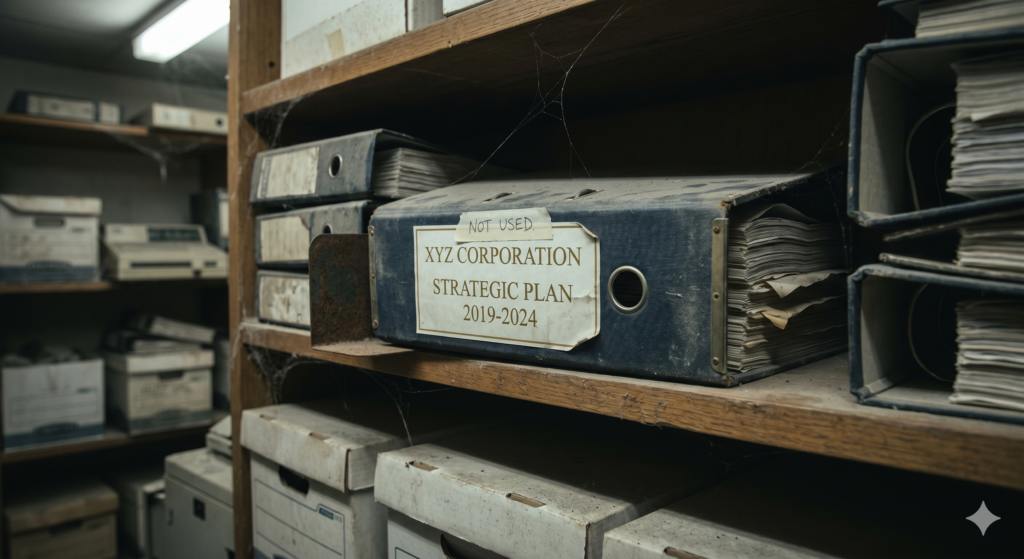
Here is what that response has cost me: I do not land every engagement. Organizations that want a boilerplate process and a timeline they can present to their board need the intake conversation just as much as anyone. They just bypass it, or find someone who will let them work around it. I understand that. But I have also sat across from enough leadership teams six months after a plan was “completed” to know what the alternative produces. A well-formatted document. And the drawer it lives in.
More often than I expected, organizations willing to have that intake conversation discover they do not need what they initially believed they did. That realization is usually more valuable than any plan we could have built without it. And it almost always saves them money.
Here is what most planning conversations skip over. Organizations are not waiting around without direction. Work is getting done, priorities are being set, decisions are being made every day. When a strategic planning process is introduced, it does not create direction from nothing. It attempts to organize or redirect what is already in motion.
People still have their day jobs. When strategic planning is layered on top of existing work rather than woven into it, it becomes one more thing to manage rather than a mechanism that brings order to what is already in motion. The goal is not to add work. It is to organize it, focus it, and reduce the noise that comes from competing priorities without a shared framework. When a plan goes underutilized, we tend to call it a lack of commitment. In many cases it is simply a reflection of a process that was never designed to fit the system it was meant to serve.
There is also an assumption baked into most planning processes that intelligent, experienced professionals can naturally produce strong strategic outputs. Strategic planning requires a specific set of skills: prioritization, systems thinking, alignment across competing interests. Those capabilities are unevenly distributed in most organizations, and people are rarely given the structure or support to develop them in real time. The outputs reflect that gap.
In larger organizations, it gets compounded. A central strategy gets cascaded across divisions with the expectation of alignment. Each unit invests significant time translating and reformatting priorities to demonstrate consistency. The result is a collection of plans that sound alike and change very little.
So, do all organizations need a strategic plan?
No. Not in the way it is commonly implemented. What every organization needs is clarity: a shared understanding of priorities, direction, and how work is organized to produce meaningful outcomes. Strategic planning can create that clarity, but only when it is designed to fit the actual system, not applied as a symbol of organizational seriousness.
The hard question worth sitting with is this: is your organization doing strategic planning to change something, or to feel like it is?
Those are not the same thing. And the answer matters a lot more than the plan.